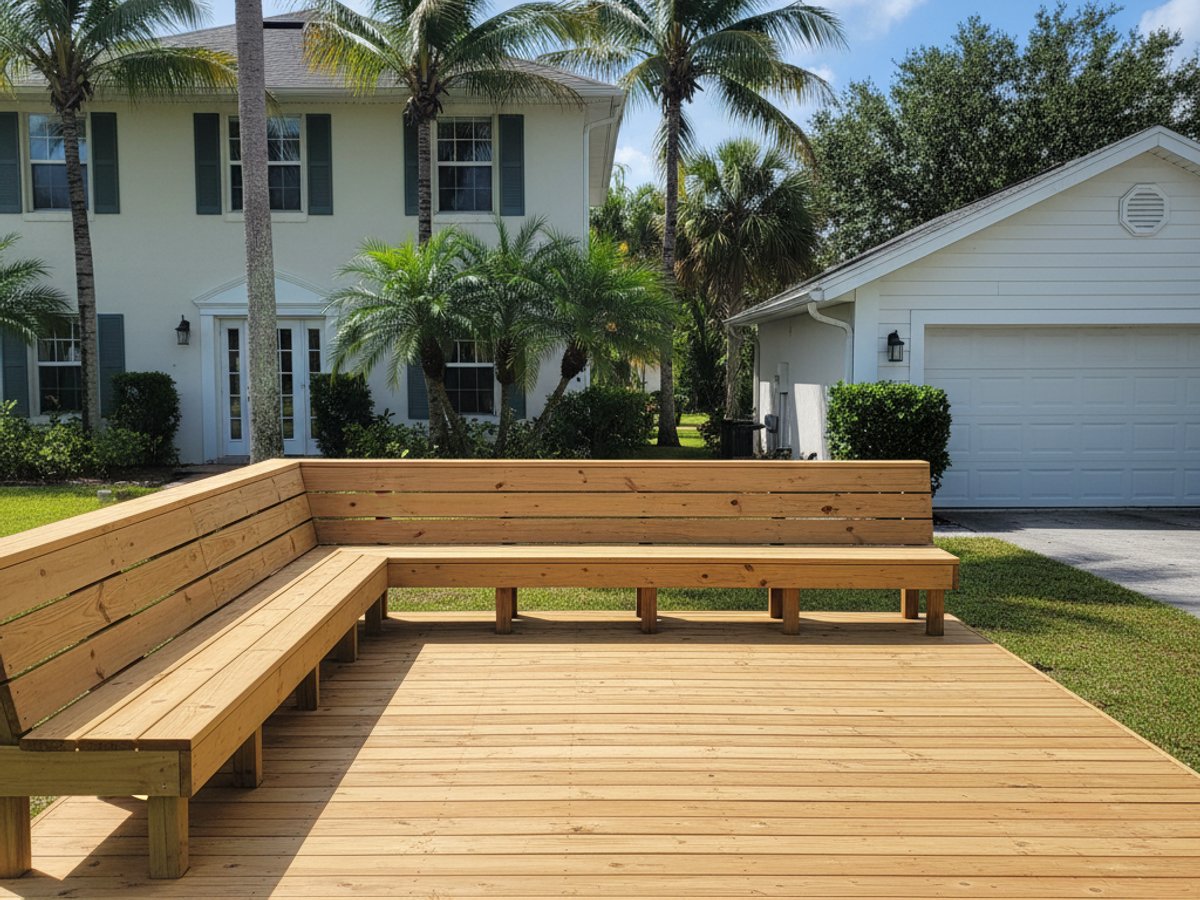
Ask a deck builder in Ohio when to schedule a build and the answer is basically "not winter, not the ground frost months." Ask someone working in Palm Harbor and the calendar looks completely different, because our problem isn't frost. It's water, humidity, and six months of afternoon thunderstorms that show up on schedule like clockwork.
What the local weather actually does to a deck build
From June through September, Pinellas County gets a thunderstorm most afternoons. It's not a maybe. Concrete footings need at least 24 to 48 hours of cure time before you can load them, and if rain keeps interrupting a pour schedule, a job that should take two weeks stretches into four. Wood framing sits out in 90% humidity and swells. Pressure-treated lumber that gets rained on and dried out repeatedly during construction moves more than lumber installed in a dry stretch, and that shows up later as boards that don't lie flat or fasteners that back out.
Sandy soil, which is most of what you've got in Palm Harbor and the surrounding Pinellas towns, actually drains fast and doesn't hold water the way clay does. That's the one thing working in our favor. But fast-draining soil during a downpour still means a job site that's mud on top and standing water in the footing holes for an hour after the rain stops.
Hurricane season isn't just a headline, it's a scheduling problem
June 1 to November 30 is hurricane season here, and even in a quiet year, you get tropical storm warnings that shut down outdoor work for two or three days at a stretch while everyone watches a forecast cone. If your project involves screened enclosures or pool decks, contractors are often reluctant to install screen panels or finish railing work when a named storm is anywhere in the Gulf, because it's wasted labor if it has to come back down. Framing that's already up and fastened usually rides out a tropical storm fine. It's the unfinished, half-secured stage of a project that's vulnerable, so nobody wants a deck sitting half-built in September.
The window that actually works: October through April
This is when most experienced builders here try to load their schedules. Rain is less frequent, humidity drops enough that lumber isn't swelling on the truck, and temperatures in the 60s and 70s are actually easier on crews than a July afternoon that hits 95 with heat index numbers that make working past 2pm miserable and unsafe. Concrete cures more predictably. Stain and sealant, which need a stretch of dry weather (48 to 72 hours minimum with no rain, ideally without heavy dew overnight either) to cure properly, actually get that stretch in November or February. Try to seal a deck in August and you're gambling against an afternoon storm before the coat has set.
That said, winter here isn't really winter. We don't get freeze-thaw cycling that cracks concrete the way it does up north, so there's no hard seasonal cutoff. A cold snap might drop us into the 30s for a night or two in January, but it's gone by breakfast. That's part of why fall through spring is such a long, workable window here instead of a tight month or two.
Not every job needs to wait for good weather
Structural repairs don't care about the calendar the way a fresh build does. If a ledger board has pulled away from the house or a joist is soft from rot, that's not something to sit on until October because the weather's nicer. Deck framing and structural repair work gets scheduled around safety, not seasons. Same with railing repair. A loose or rotted rail post is a fall risk today, not a project for next spring.
Staining and sealing is the one where timing really does matter for the outcome, not just the convenience. Apply a sealant right before a summer storm rolls in and you can end up with a cloudy, uneven finish that has to be sanded back and redone. Composite decking is more forgiving of moisture during install since it doesn't absorb water and swell the way wood does, but even composite boards expand and contract with heat, so builders leave gap spacing (usually around 1/8 inch to 3/16 inch depending on the product and the board length) to account for a Florida summer versus a January morning.
Permits, inspections, and how the timing lines up
Most deck work in Palm Harbor falls under Pinellas County permitting since a lot of the area is unincorporated, though it depends on the exact address. A new deck or a structural rebuild typically needs a permit, and there's usually a footing inspection before you pour, and a framing inspection before the decking boards go down and hide everything underneath. If your property is on well-drained sandy soil near one of the canals or close to Lake Tarpon, expect the inspector to pay attention to how footings are set relative to the water table, especially after a wet season when the ground's saturated. Neighborhoods like Lansbrook and Ridgemoor also have HOA design review on top of the county permit, and HOAs move slower in summer when half the review committee is on vacation, so plan an extra few weeks if you're in one of those communities.
Older streets around downtown Palm Harbor, with houses from the 1970s and 80s, often have decks tied into framing and utility lines that were never inspected to today's code. Expect more surprises once a repair crew opens things up, compared to a five-year-old deck in a newer subdivision where everything's still where the plans say it should be.
Bottom line on when to call
If you're planning a new build, a full replacement, or anything involving fresh concrete and stain, aim to get on a schedule for the October to April window. Builders book up fast once the weather turns, so calling in August for a November start is normal, not early. If something's broken, rotted, or unsafe, don't wait for good weather. That's what repair work is for. We've done both kinds of jobs in every month of the year, and Omega Deck Solutions can tell you honestly which one your project actually is.